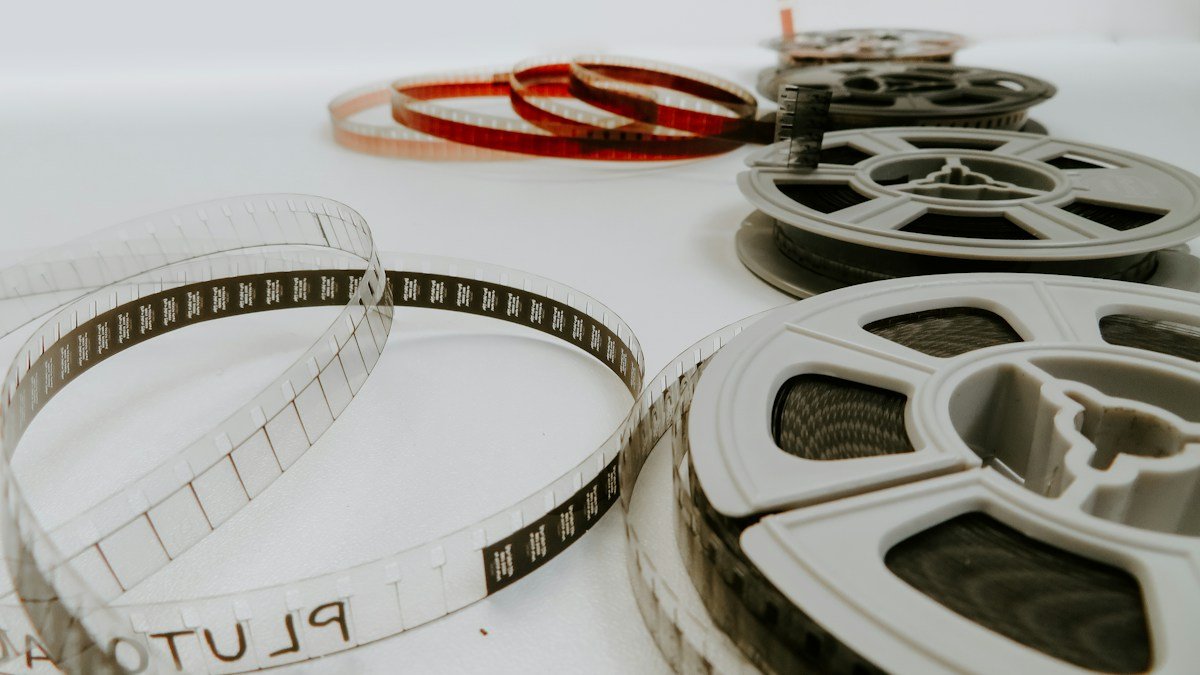
In contemporary post-production, combining multiple visual elements—such as placing an actor in front of a distant skyline or superimposing a ghost into a room—takes minutes in digital node-based compositing software like Nuke or After Effects. Yet for over six decades, every multi-layered composite in Hollywood had to be crafted through delicate mechanical synchronization, chemical photochemical baths, and the legendary workhorse of cinematic wizardry: **The Optical Printer**.
1. The Mechanical Anatomy of the Optical Printer
Invented in the early 1930s and perfected by Linwood Dunn at RKO Studios, an **Optical Printer** is fundamentally a high-precision motion picture projector optically coupled face-to-face with a motion picture camera, mounted on a rigid cast-iron optical lathe bed.
Its primary mechanical assemblies include:
- The Projector Head (Printer Gate): Holds the previously developed master positive or negative film strip. Equipped with high-tolerance Mitchell pilot registration pins.
- The Process Lens: A specialized flat-field apochromatic macro lens (such as a 105mm or 150mm Apo-Nikkor) optimized for 1:1 optical reproduction with zero optical barrel distortion and zero chromatic aberration.
- The Camera Head: Loaded with raw, unexposed film stock (internegative stock like Eastman 5272), precisely aligned along the optical axis.
- The Interlocking Drive Motor: Precision synchronous motors and mechanical drive shafts that advance the projector and camera frames in exact, frame-accurate synchronization (1-to-1, 2-to-1, or single-frame stepping).
2. The Traveling Matte Process: Blue Screen Photochemistry
The crowning achievement of optical printing was the **Traveling Matte**, which allowed moving actors shot against a colored backing to be composited seamlessly over a completely separate background plate.
Pioneered by Petro Vlahos at Warner Bros. and perfected for The Thief of Bagdad (1940) and Mary Poppins (1964), the process relied on complex multi-generation photochemical separations:
3. The Final Composite Pass in the Printer
Once the male and female traveling mattes were chemically developed and verified on an optical inspection bench, the optical printer operator executed a delicate **dual-pass composite exposure**:
- First Pass (The Background Plate): The raw film stock is loaded into the camera head. In the projector head, the background plate (e.g., a matte painting of a sci-fi city) is loaded in “bipack” (sandwiched emulsion-to-emulsion) with the **Female Holdout Matte**. As the printer runs frame-by-frame, light exposes the city background onto the raw stock—except where the opaque black silhouette of the actor blocks the light, leaving an unexposed, pristine black “hole” shaped like the actor.
- The Rewind: The camera operator carefully caps the camera lens, winds the unexposed raw stock backwards by exactly 500 frames, verifying physical perforation counters to the single sprocket hole.
- Second Pass (The Foreground Actor): The projector head is reloaded with the original foreground actor footage bipacked with the **Male Cover Matte**. Light exposes the actor into the exact unexposed black silhouette hole left during the first pass.
When the composite roll was removed and developed in the laboratory, the actor and the background merged into a single photographic universe.
4. The Sodium Vapor Process: Disney’s “Yellow Screen” Secret
While blue screen traveling mattes were Hollywood’s frontline method, blue spill frequently polluted blond hair, translucent glass, and flowing fabrics, creating visible dark blue halos (matte lines) around actors.
To achieve absolute perfection on Mary Poppins (1964) and Bedknobs and Broomsticks (1971), Walt Disney Studios utilized Petro Vlahos’s revolutionary **Sodium Vapor Process**.
The Dual-Prism Sodium Camera
The set was backed by a screen flooded with low-pressure sodium vapor lamps emitting at a single, hyper-narrow spectral wavelength: exactly **589.3 nanometers** (a distinct amber yellow).
Disney modified a specialized Technicolor 3-strip camera equipped with a custom dichroic beam-splitter prism:
- The coating on the prism reflected ONLY the narrow 589.3nm sodium yellow wavelength onto a dedicated black-and-white high-contrast film stock running through the side gate. This instantly recorded a **flawless, 100% accurate traveling matte in real-time** inside the camera body!
- All other visible light passed straight through to expose standard color negative film in the rear gate with zero yellow pollution.
Because the matte was captured simultaneously in the camera gate through the same objective lens, it exhibited zero registration shrinkage error, allowing Mary Poppins’ transparent chiffon scarves and flying hair to composite cleanly over animated cartoon backgrounds with zero matte lines.
5. Why Modern Compositors Still Study Optical Printing
Every tool inside modern digital compositing software is a direct digital translation of physical optical printing mechanics:
- The “A Over B” merge node is a mathematical emulation of the dual-pass optical exposure.
- The “Garbage Matte” is a digital recreation of physical black cardboard cutters placed on lathe stages.
- “Light Wrap” algorithms simulate the physical bleed of intense backlight photons spilling around microscopic silver grains on high-contrast film gates.
Frequently Asked Questions
Q1: Why did visual effects sequences in 1970s movies often look grainier than the rest of the film?
A: Because of the “generation loss” inherent in optical printing. Every time a film negative is copied onto master positive and re-photographed onto internegative stock, film grain compounds. A complex four-element optical shot could be 4th or 5th generation celluloid. To combat this, ILM famously shot all VFX miniature plates for Star Wars on 8-perf VistaVision (35mm running horizontally), ensuring that even after optical generation loss, the resolution matched standard 4-perf live action.
Q2: What is an optical dissolve and how was it executed on an optical printer?
A: A dissolve is a transition where Scene A fades out while Scene B fades in. In the printer, the operator smoothly closed the camera shutter from 180° to 0° over 48 frames, wound the film back 48 frames, loaded Scene B, and opened the shutter from 0° to 180° over the identical 48 frames, blending the exposures together.
6. The Chemistry of Interpositive and Internegative Stock
A primary technical challenge of optical printing was preventing image degradation across multiple chemical generations. If an original camera negative (OCN) was copied onto standard release print stock and re-photographed, the contrast skyrocketed, blacks crushed completely, and grain clumps ballooned uncontrollably.
To conquer this, Eastman Kodak engineered specialized intermediate motion picture film stocks:
- Color Intermediate Stock (Kodak 5243 / 5272): Formulated with a mathematically flat gamma curve (gamma = 1.0). When an image is printed onto 5243, it reproduces density with near-zero contrast boost.
- Micro-Fine Grain Structure: Intermediate emulsions use ultra-refined silver halide micro-crystals that are less than one-third the size of camera negative crystals, ensuring that when the intermediate positive (IP) is re-photographed onto the internegative (IN), minimal optical grain noise is introduced into the composite.
7. The Schüfftan Process: Mirror Magic on Fritz Lang’s Metropolis
Decades before optical traveling mattes were perfected, German cinematographer Eugen Schüfftan invented an astonishing in-camera optical compositing method for Fritz Lang’s 1927 sci-fi monument Metropolis: the **Schüfftan Process**.
The 45-Degree Mirror Architecture
The Schüfftan Process combined live actors and tiny miniature architectural models in a single, instantaneous camera exposure:
- A plate-glass mirror was mounted in front of the camera lens at an exact **45-degree angle**.
- The mirror reflected a highly detailed miniature model of the towering skyscrapers of Metropolis situated off to the side of the stage.
- Technicians looked through the camera viewfinder and carefully scraped away the metallic silver reflection backing from specific small sections of the glass mirror using razor blades.
- Through these clear, scraped glass windows, the camera lens looked directly past the mirror onto live human actors performing on a distant stage platform.
Because both the miniature reflection and the live actor passed through the objective lens into the film gate simultaneously, the resulting negative required zero chemical laboratory printing passes, producing razor-sharp, flawless composites with zero generation loss!
8. Optical Printer Alignment & Quality Control Table
9. The Traveling Matte Chemistry Laboratory Protocol
In high-end optical effects laboratories (such as Technicolor Hollywood or ILM’s optical department in the 1970s), photochemical processing of traveling mattes required surgical laboratory precision:
- Sensitometric Gamma Balancing: High-contrast black-and-white Kodalith film was developed in aggressive hydroquinone chemical baths (Kodak D-8 developer) to achieve a near-infinite photographic gamma (gamma > 8.0). This ensured that clear areas were 100% transparent while black areas achieved an optical density exceeding D-max 3.5, preventing the background image from bleeding through the actor’s silhouette during the second optical pass.
- Shrinkage Compensation: Because physical cellulose acetate film shrinks by roughly 0.1% to 0.2% during chemical immersion, optical printers utilized micro-adjustable pitch gates. Technicians measured perforation pitch with optical comparator gauges, ensuring that male and female mattes aligned with sub-micron precision to eliminate matte fringing.
10. Summary: The Mechanical Mainframe of Classic Cinema
In closing, optical printing was one of the greatest triumphs of mechanical optical engineering in human history. By utilizing precision lathe beds, liquid immersion gates, and multi-generation dye chemistry, classical Hollywood craftsmen established the language of multi-plane visual compositing upon which all modern digital cinema tools continue to build.
11. The Legacy of Optical Compositing in the Digital Era
Although digital compositing software has replaced physical optical printing benches, the fundamental concepts developed by classical optical technicians remain the bedrock of modern visual effects. The mathematical principles of alpha channel blending, holdout mattes, edge fringing suppression, and grain balancing all trace their direct lineage to the physical darkrooms of classic Hollywood.
Understanding how physical photons interacted with high-contrast gelatin emulsions equips contemporary digital artists with an intuitive understanding of image physics, ensuring that modern digital composites retain the photographic realism and optical soul of traditional cinema.
12. Practical Laboratory Preservation and Restoration Challenges
Restoring multi-layer optical composites from classic cinema requires modern digital restoration facilities (such as Warner Bros. MPI or Criterion) to scan original separation negatives in 4K or 8K 16-bit color. Because physical film shrinks over decades at slightly different rates across color separation layers, digital restoration software uses sub-pixel optical flow warping algorithms to re-align historical traveling mattes, eliminating vintage blue fringing and restoring classic cinema to its original theatrical brilliance.